The most comprehensive marketplace for data center solutions.
Company
Quick Links
Marketplace
Latest News
Sitemap
Solution
Support

Datacentermart.com. All rights reserved

Home

Community

Marketplace

Get Quote


Modern businesses depend heavily on reliable IT infrastructure to support applications, store critical data, and ensure uninterrupted operations. As organizations expand their digital presence, selecting the right data center strategy becomes an important business decision. Two of the most common options are Enterprise Data Centers and Colocation Data Centers. While both provide secure environments for hosting servers and networking equipment, they differ in ownership, management, scalability, and overall cost. Understanding these differences helps businesses choose a solution that aligns with their operational requirements, budget, and long-term growth plans.
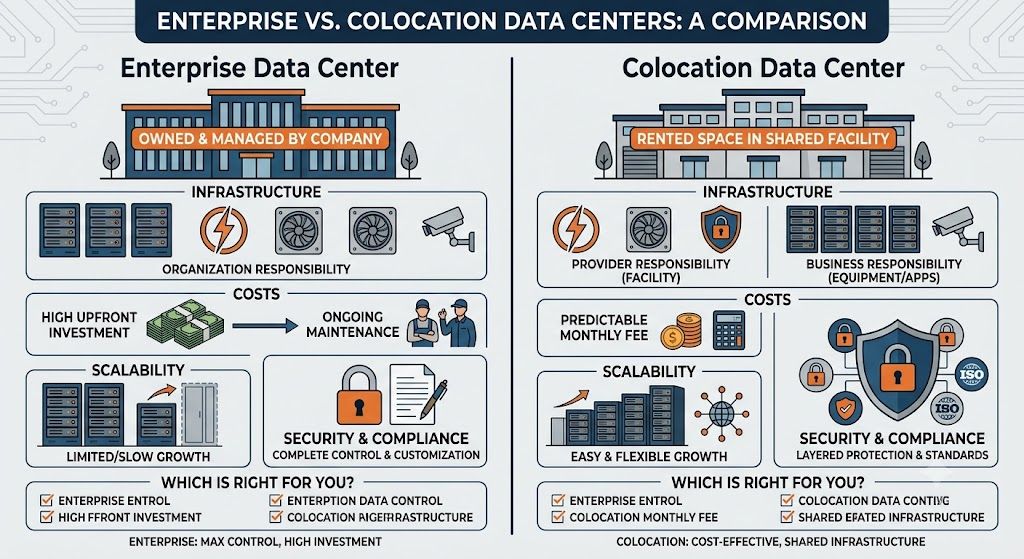
An Enterprise Data Center is a facility that is owned, operated, and maintained by a single organization. The business is responsible for every aspect of the infrastructure, including the building, servers, storage systems, networking equipment, power distribution, cooling systems, and physical security. Because the entire environment is privately managed, organizations have complete control over their IT operations, security policies, and infrastructure design. Enterprise data centers are commonly used by large enterprises, financial institutions, government agencies, and healthcare organizations that require dedicated resources and strict compliance with industry regulations.
A Colocation Data Center is a professionally managed facility where businesses rent space to house their own servers and networking equipment. Unlike an enterprise data center, the customer owns the hardware while the colocation provider is responsible for maintaining the building, power systems, cooling infrastructure, physical security, and network connectivity. This model allows organizations to benefit from enterprise-grade facilities without the significant investment required to build and maintain a private data center. Colocation services are widely used by businesses seeking reliable infrastructure with greater flexibility and reduced operational complexity.
One of the primary differences between enterprise and colocation data centers lies in how the infrastructure is managed. In an enterprise data center, the organization is responsible for managing every component, from hardware maintenance to power systems and environmental controls. This approach provides complete operational control but also requires significant technical expertise and ongoing maintenance. In contrast, a colocation provider manages the facility's core infrastructure, allowing businesses to focus primarily on their servers, applications, and business operations while benefiting from professionally maintained data center services.
The financial investment required for each model varies considerably. Building an enterprise data center involves substantial upfront costs, including land acquisition, construction, electrical infrastructure, cooling systems, networking equipment, and ongoing maintenance expenses. These costs can be difficult to justify for small and medium-sized businesses. Colocation, on the other hand, operates on a rental model where organizations pay for rack space, power consumption, and related services. This significantly reduces capital expenditure while providing access to high-quality infrastructure that would otherwise require a major investment.
Business growth often demands additional computing resources, storage, and network capacity. Expanding an enterprise data center may require purchasing new equipment, increasing power capacity, or even constructing additional facilities, making scalability both expensive and time-consuming. Colocation data centers offer far greater flexibility, enabling businesses to increase rack space, bandwidth, and power allocation as their requirements evolve. This makes colocation an attractive choice for organizations experiencing rapid growth or fluctuating infrastructure demands.
Security remains one of the most important aspects of any data center. Enterprise data centers allow organizations to implement customized physical and cybersecurity measures based on their internal policies and regulatory requirements. This level of control is beneficial for industries with strict compliance standards. Colocation providers also maintain robust security through multiple layers of protection, including controlled access, surveillance systems, environmental monitoring, and redundant infrastructure. Many leading providers also comply with internationally recognized security and operational standards, giving customers confidence in the safety and reliability of their hosted infrastructure.
Maintaining continuous uptime is essential for modern businesses. Enterprise data centers require organizations to invest in backup power systems, cooling redundancy, disaster recovery planning, and dedicated support teams to achieve high availability. Colocation facilities are specifically designed with redundancy across power, networking, and cooling systems to minimize downtime and maintain reliable operations. Because these facilities serve multiple customers, providers typically invest heavily in resilient infrastructure that supports uninterrupted business services.
The choice between an enterprise data center and a colocation data center depends on an organization's operational priorities, financial resources, and long-term IT strategy. Large enterprises that require complete control, customized infrastructure, and dedicated security may find an enterprise data center to be the most suitable solution despite the higher investment. Businesses seeking enterprise-grade reliability, reduced operational responsibilities, predictable costs, and easier scalability often benefit more from colocation services. Carefully evaluating current infrastructure needs and future business growth will help organizations determine the most effective data center approach.
Both enterprise and colocation data centers play a vital role in supporting modern business operations, but they are designed to address different organizational needs. Enterprise data centers provide maximum control and customization, making them suitable for organizations with specialized requirements and the resources to manage their own facilities. Colocation data centers offer a cost-effective alternative by combining customer-owned hardware with professionally managed infrastructure, enabling businesses to achieve high reliability, security, and scalability without the complexity of operating a private data center. Choosing the right model ultimately depends on balancing business objectives, technical requirements, and long-term growth plans.