The most comprehensive marketplace for data center solutions.
Company
Quick Links
Marketplace
Latest News
Sitemap
Solution
Support

Datacentermart.com. All rights reserved

Home

Community

Marketplace

Get Quote


Modern data centers are the foundation of cloud computing, artificial intelligence, financial platforms, healthcare systems, and digital services across the USA. As compute density increases and workloads become more power-intensive, traditional air-based cooling methods struggle to meet efficiency, sustainability, and performance requirements.Liquid immersion cooling in modern data centers has emerged as a transformative solution that addresses these challenges while supporting the future of high-density infrastructure.
As organizations deploy AI, high-performance computing (HPC), and edge workloads, thermal management has become a critical operational concern. Liquid immersion cooling in modern data centers offers a reliable way to reduce energy consumption, control heat more effectively, and enable scalable growth without excessive infrastructure expansion.
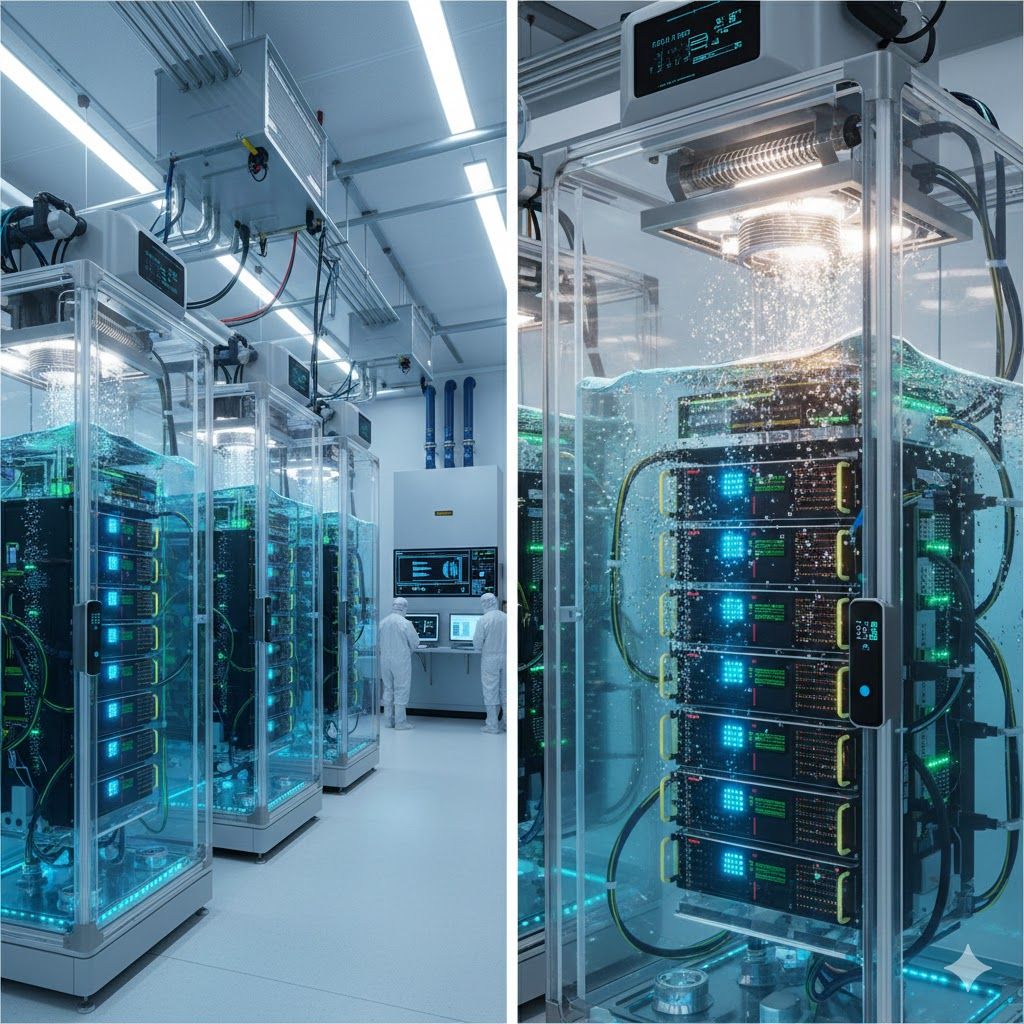
Liquid immersion cooling is an advanced thermal management approach where servers and IT components are submerged directly into a non-conductive dielectric liquid. Instead of relying on air circulation and traditional cooling units, heat is transferred efficiently from hardware into the surrounding liquid.
Liquid immersion cooling in modern data centers eliminates many limitations of conventional airflow-based systems. The liquid absorbs heat directly from processors, memory, and power components, enabling consistent temperatures even under extreme workloads. This method significantly reduces dependency on fans, chillers, and raised-floor designs.
Air-based data center cooling was designed for lower-density workloads. Today’s AI models, GPU clusters, and machine learning platforms generate far more heat per rack than traditional servers. As a result, air cooling becomes inefficient, expensive, and difficult to scale.Common challenges include uneven airflow, hot spots, high power consumption, and rising operational costs. Data center cooling systems based on air often require extensive floor space, complex ducting, and high fan energy usage.Liquid immersion cooling in modern data centers directly addresses these limitations by delivering uniform heat removal, reducing mechanical complexity, and improving thermal stability across all hardware components.
One of the strongest drivers for liquid immersion cooling adoption is energy efficiency. Cooling systems account for a significant portion of a data center’s total power usage. By eliminating fans and minimizing air handling systems, liquid immersion cooling dramatically reduces energy waste.Liquid immersion cooling in modern data centers can improve Power Usage Effectiveness (PUE), helping organizations meet sustainability targets and regulatory requirements. Lower cooling energy consumption also reduces carbon emissions, making this technology attractive for environmentally conscious enterprises.In the USA, where energy costs and environmental compliance are growing concerns, liquid immersion cooling provides long-term operational and financial advantages.
Artificial intelligence, deep learning, and high-performance computing workloads demand dense hardware configurations that generate intense heat. Traditional data center cooling methods struggle to support these environments without excessive cost and complexity.Liquid immersion cooling in modern data centers enables higher rack densities without compromising reliability. Servers can operate at optimal temperatures even during peak workloads, improving performance consistency and extending hardware lifespan.This capability is especially valuable for cloud providers, research institutions, and enterprises deploying AI-driven platforms across the USA.
Air-cooled facilities require raised floors, containment systems, cooling ducts, and extensive airflow management. These elements increase design complexity and limit flexibility during expansion.Liquid immersion cooling simplifies data center cooling architecture by removing many of these components. Facilities can be designed with smaller footprints, higher compute density, and modular expansion options.Liquid immersion cooling in modern data centers also reduces noise levels and mechanical wear, resulting in lower maintenance requirements and improved operational stability.
Lower energy usage, reduced cooling equipment, and simplified infrastructure directly translate into cost savings. Organizations using liquid immersion cooling benefit from reduced electricity bills, fewer mechanical failures, and lower maintenance overhead.Over time, liquid immersion cooling in modern data centers helps offset initial deployment costs through improved efficiency and extended hardware life cycles. These financial benefits are particularly important for organizations managing large-scale environments or planning long-term capacity growth.
Stable operating temperatures play a key role in preventing hardware failures. Fluctuating thermal conditions increase wear on components, leading to higher failure rates and downtime.Liquid immersion cooling provides uniform and consistent cooling, protecting sensitive electronics from thermal stress. By eliminating dust exposure and reducing vibration from fans, liquid immersion cooling in modern data centers improves overall system reliability.This enhanced reliability is critical for industries such as finance, healthcare, government, and telecom, where downtime carries significant risk.
Several industries across the USA are leading the adoption of liquid immersion cooling. Cloud service providers use it to support massive AI workloads efficiently. Financial institutions depend on reliable and scalable infrastructure to meet compliance and performance requirements.
Healthcare organizations rely on advanced data center cooling solutions to support critical systems and data-intensive applications. Media, research, and defense sectors also benefit from the efficiency and resilience offered by liquid immersion cooling in modern data centers.
As digital transformation accelerates, the demand for efficient, scalable, and sustainable infrastructure will continue to grow. Liquid immersion cooling is positioned as a long-term solution that aligns with emerging technologies and environmental goals.Advancements in dielectric fluids, system design, and integration tools are making liquid immersion cooling more accessible to organizations of all sizes. Combined with AI-driven monitoring and automation, liquid immersion cooling in modern data centers represents the next evolution of data center cooling strategies.
What is liquid immersion cooling in modern data centers?
It is a cooling method where IT hardware is submerged in non-conductive liquid to remove heat more efficiently than air cooling.
Is liquid immersion cooling suitable for all data centers?
It is best suited for high-density, AI, and performance-critical environments but can be adapted for various use cases.
Does liquid immersion cooling reduce energy costs?
Yes. It significantly lowers cooling-related power consumption and improves overall efficiency.
Is liquid immersion cooling safe for IT equipment?
When designed and implemented correctly, it is highly safe and improves hardware reliability.