
The most comprehensive marketplace for data center solutions.
Company
Quick Links
Marketplace
Latest News
Sitemap
Solution
Support

Datacentermart.com. All rights reserved

Home

Community

Marketplace

Get Quote


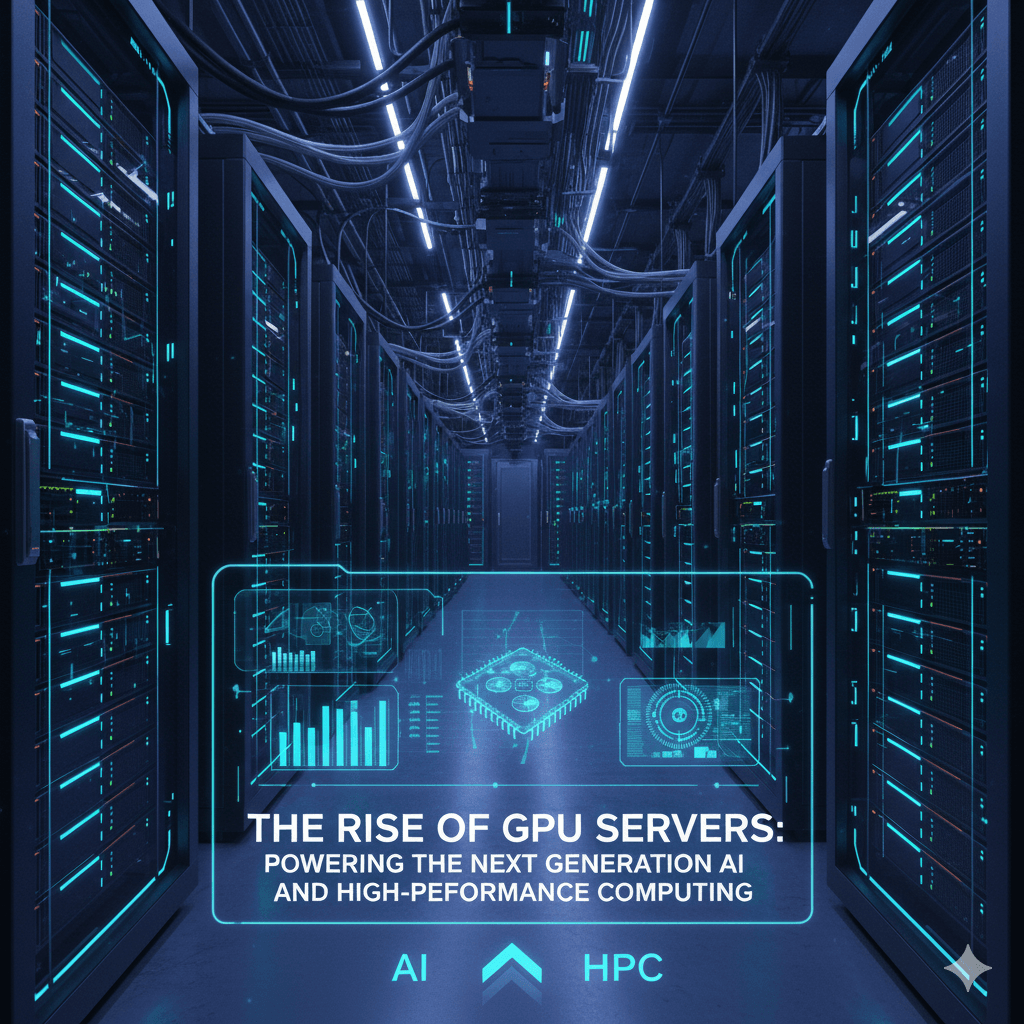
In today’s digital era, the demand for faster processing, real-time analytics, and intelligent automation is growing rapidly. Businesses, research institutions, and technology providers are increasingly turning toward GPU Servers: Driving AI and High-Performance Computing to meet these advanced computing requirements. From artificial intelligence to scientific simulations, GPU-powered infrastructure has become the backbone of innovation. As data volumes continue to grow exponentially, traditional CPU-based systems often struggle to keep up. This is where GPU servers step in and transform the computing landscape.
A GPU server is a specialized system equipped with one or more Graphics Processing Units (GPUs) designed to handle parallel processing tasks efficiently. Unlike CPUs, which are optimized for sequential processing, GPUs are built to execute thousands of threads simultaneously. This architecture makes GPU servers highly effective for complex mathematical computations, deep learning models, and large-scale simulations.The concept of GPU Servers: Driving AI and High-Performance Computing revolves around accelerating workloads that require intense computational power. Modern AI applications, including natural language processing, computer vision, and predictive analytics, depend heavily on GPU acceleration. Organizations adopting GPU servers gain significant improvements in performance, scalability, and operational efficiency.
Artificial Intelligence (AI) requires massive computational resources to train and deploy machine learning models. Training deep neural networks involves processing enormous datasets and performing millions of matrix calculations. GPU servers dramatically reduce training time compared to traditional CPU-based systems.When discussing GPU Servers: Driving AI and High-Performance Computing, AI remains one of the most important applications. Industries such as healthcare, finance, retail, and autonomous vehicles rely on GPU-powered AI systems to deliver accurate insights and automation. For example, medical image analysis benefits from GPU acceleration to detect diseases faster and more accurately.By leveraging GPU servers, organizations can process data in parallel, enabling real-time decision-making and enhanced AI capabilities. This advantage is critical in environments where milliseconds matter.
High-Performance Computing (HPC) involves solving complex scientific and engineering problems that require enormous computational resources. Fields such as climate modeling, molecular dynamics, aerospace simulations, and energy research depend on HPC systems.The phrase GPU Servers: Driving AI and High-Performance Computing perfectly captures how GPUs have transformed HPC infrastructure. GPU servers accelerate workloads by offloading computationally intensive tasks from CPUs to GPUs. This hybrid architecture significantly improves throughput and reduces processing time.Research institutions and enterprises invest in GPU servers to build supercomputing clusters capable of handling petabytes of data. These systems enable faster experimentation, reduced time-to-market, and groundbreaking discoveries.
1. Enhanced Performance
GPU servers deliver exceptional performance by leveraging parallel processing. Tasks that once took hours or days can now be completed in minutes. This performance boost is a primary reason why organizations adopt GPU Servers: Driving AI and High-Performance Computing strategies.
2. Scalability
Modern GPU servers are highly scalable. Businesses can add additional GPUs to scale their infrastructure as workloads grow. This flexibility supports both small AI startups and large enterprises with demanding workloads.
3. Energy Efficiency
Despite their high performance, GPU servers can be more energy-efficient than CPU-only systems for parallel workloads. By completing tasks faster, they reduce overall power consumption per task.
4. Cost-Effectiveness
Although GPU servers may require a higher initial investment, their performance efficiency reduces long-term operational costs. Faster processing leads to improved productivity and lower infrastructure expenses.
Cloud service providers now offer GPU-enabled instances to support AI and HPC workloads. Businesses can access powerful GPU resources without investing in on-premises hardware. This cloud adoption model aligns with the concept of GPU Servers: Driving AI and High-Performance Computing by providing flexibility and scalability.Cloud-based GPU servers allow organizations to experiment with AI models, conduct simulations, and deploy applications globally. This model reduces capital expenditure while ensuring high availability and performance.
Implementing GPU servers requires careful planning. Organizations must consider factors such as cooling, power supply, rack space, and networking bandwidth. GPU workloads generate significant heat, so efficient cooling systems are essential.Additionally, software optimization plays a crucial role. AI frameworks like TensorFlow and PyTorch are optimized for GPU acceleration. Proper configuration ensures maximum utilization and performance.Companies aiming to implement GPU Servers: Driving AI and High-Performance Computing strategies should evaluate workload requirements, scalability goals, and budget constraints before deployment.
The future of computing is heavily influenced by artificial intelligence and data-driven innovation. As AI models grow more complex, demand for GPU acceleration will continue to increase. Emerging technologies such as generative AI, edge computing, and quantum simulations rely on high-performance GPU infrastructure.The evolution of GPU hardware is also accelerating. Modern GPUs feature advanced memory architectures, higher core counts, and improved interconnect technologies. These advancements further strengthen the role of GPU Servers: Driving AI and High-Performance Computing in next-generation data centers.Moreover, industries are moving toward hybrid architectures that combine CPUs, GPUs, and specialized accelerators. This integrated approach ensures optimal performance for diverse workloads.
While GPU servers offer numerous benefits, they also present challenges. High initial costs, complex deployment processes, and the need for skilled professionals can be barriers. However, managed services and cloud-based GPU solutions help mitigate these issues.Organizations investing in GPU Servers: Driving AI and High-Performance Computing must also focus on cybersecurity, data management, and compliance. Ensuring secure access and data protection is critical for maintaining operational integrity.Training IT teams and adopting automation tools can further streamline GPU server management. With proper planning and expertise, these challenges can be effectively addressed.
What are GPU servers?
GPU servers are high-performance computing systems equipped with one or more Graphics Processing Units (GPUs). They are specifically designed to handle parallel processing tasks such as artificial intelligence (AI), machine learning, scientific simulations, and large-scale data analytics.
How are GPU servers different from CPU servers?
CPU servers are optimized for sequential processing and general-purpose tasks. GPU servers, on the other hand, are designed for parallel processing, allowing thousands of computations to run simultaneously. This makes GPU servers much faster for AI training, deep learning, and high-performance computing workloads.
Why are GPU servers important for AI?
AI model training requires heavy mathematical computations and large dataset processing. GPU servers significantly reduce training time by performing multiple calculations at once. This enables faster model development, real-time predictions, and improved AI performance.
What industries use GPU servers?
GPU servers are widely used in healthcare (medical imaging and diagnostics), finance (risk modeling and fraud detection), research (scientific simulations), media and entertainment (3D rendering and video processing), automotive (autonomous vehicles), and cloud service providers.