The most comprehensive marketplace for data center solutions.
Company
Quick Links
Marketplace
Latest News
Sitemap
Solution
Support

Datacentermart.com. All rights reserved

Home

Community

Marketplace

Get Quote


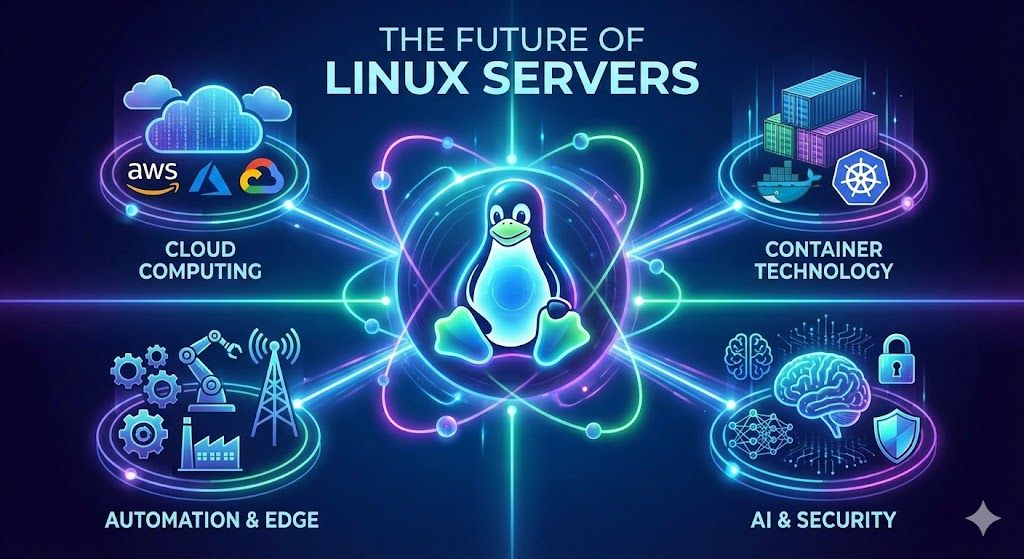
Linux servers have become the backbone of modern IT infrastructure. From cloud platforms and enterprise applications to DevOps pipelines and container orchestration, Linux powers a large portion of today’s digital services. As organizations accelerate cloud adoption and digital transformation initiatives, the role of Linux servers continues to expand across industries.
In the USA and globally, businesses are increasingly relying on Linux-based environments to support automation, scalability, and innovation. The future of Linux servers is closely tied to cloud automation and digital transformation strategies that demand flexibility, performance, and cost efficiency.
Linux provides an open, secure, and highly customizable foundation that enables organizations to modernize infrastructure, streamline operations, and adapt to rapidly changing technology demands.
Linux servers form the core of most public, private, and hybrid cloud environments. Major cloud providers rely heavily on Linux to run virtual machines, containers, and managed services due to its stability and performance.
Through automation tools, scripting, and cloud-native integrations, Linux servers enable faster provisioning, configuration management, and workload deployment. This flexibility makes Linux essential for organizations pursuing scalable and efficient cloud architectures.
Traditional server infrastructures often struggle to keep up with modern business demands. Manual provisioning, limited scalability, and rigid architectures slow down innovation and increase operational overhead. As application workloads grow more dynamic, these limitations become more apparent.
Legacy server management relies heavily on manual configuration, static resource allocation, and reactive maintenance. These approaches lead to inefficiencies, higher downtime risk, and slower response to changing workload requirements.
Linux servers help overcome these challenges by supporting automation, orchestration, and dynamic resource management.
Cloud automation is transforming how infrastructure is deployed and managed, and Linux is at the center of this shift. Automation frameworks, Infrastructure as Code (IaC), and configuration management tools run natively on Linux environments.
By automating repetitive tasks and standardizing deployments, Linux servers enable consistent, error-free operations across cloud platforms. This shift allows IT teams to focus on innovation rather than manual administration.
Digital transformation requires agility, scalability, and continuous delivery of services. Linux servers support these goals by integrating seamlessly with modern development and deployment practices.
Linux is the preferred platform for DevOps pipelines, container technologies, and microservices architectures. Tools such as Docker, Kubernetes, Ansible, and Terraform run efficiently on Linux servers, enabling rapid application development and deployment.
This ecosystem allows organizations to modernize applications, improve time-to-market, and support continuous innovation.
Organizations using automated Linux server environments often experience faster deployment times by up to 50 percent. Improved system availability and proactive monitoring reduce downtime significantly. Automation-driven efficiency also lowers infrastructure and operational costs while improving overall performance.
The future of Linux servers is closely linked to cloud automation and digital transformation. By enabling scalable, secure, and automated infrastructure, Linux continues to drive innovation across modern IT environments.
As businesses evolve toward cloud-native and digital-first models, Linux servers remain a foundational technology for long-term success.
Organizations planning cloud adoption or infrastructure modernization should prioritize Linux-based platforms. Partnering with experienced consulting and managed service providers helps ensure successful automation, optimized performance, and sustainable digital transformation.
How do Linux servers support cloud automation?
Linux supports automation tools, scripting, and orchestration platforms that enable faster and more reliable infrastructure management.
Are Linux servers suitable for enterprise environments?
Yes. Linux is widely used in enterprise, cloud, and mission-critical environments due to its stability and security.
Do Linux servers reduce operational costs?
Yes. Automation, efficient resource usage, and open-source licensing help reduce overall infrastructure costs.
Is Linux secure for cloud and digital workloads?
When properly configured and maintained, Linux provides strong security features and compliance support.