The most comprehensive marketplace for data center solutions.
Company
Quick Links
Marketplace
Latest News
Sitemap
Solution
Support

Datacentermart.com. All rights reserved

Home

Community

Marketplace

Get Quote


Choosing the right location for a data center is a strategic decision that directly affects performance, availability, cost, and long-term growth. Organizations that fail to evaluate locations properly often face operational inefficiencies, higher expenses, and increased risk. This is why understanding data center site selection criteria is essential for enterprises, cloud providers, and colocation operators.As digital services continue to expand, businesses rely on data centers to support applications, storage, and network services that must run continuously. Applying the right data center site selection criteria helps organizations build facilities that are resilient, compliant, and future-ready.
The data center site selection process determines how well a facility can support business objectives. Once a data center is constructed, changing its location is costly and complex. Decisions made at the planning stage influence capital investment, operating costs, and service reliability for many years.A well-planned approach to data center site selection criteria ensures that the chosen site can handle current workloads while supporting future expansion. It also minimizes risks related to power outages, natural disasters, and regulatory constraints.
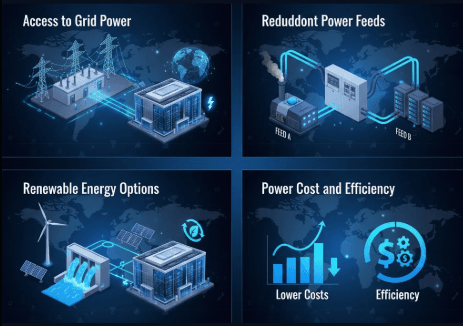
Reliable power is one of the most critical data center site selection criteria. Data centers require uninterrupted electricity to maintain uptime and protect equipment. Even brief outages can cause data loss and service disruption.When evaluating sites, organizations assess access to multiple power substations, dual utility feeds, and backup generation options. Power cost is also a major factor in data center site selection, as electricity represents a large portion of operational expenses. Regions with stable grids and access to renewable energy sources are increasingly preferred.
High-quality connectivity is fundamental to effective data center site selection criteria. A data center must support fast, reliable communication between users, cloud platforms, and enterprise systems.Key considerations include access to multiple network providers, diverse fiber paths, and proximity to internet exchange points. A well-connected data center location reduces latency, improves application performance, and ensures redundancy in case of carrier failure. Strong network infrastructure is especially important for industries that depend on real-time data processing.
Geographic risk assessment is a core part of data center site selection. Environmental threats can significantly impact uptime and infrastructure safety.Organizations analyze historical data related to earthquakes, floods, hurricanes, and extreme weather conditions. A stable data center location with low natural disaster risk improves resilience and reduces insurance and recovery costs. Climate conditions also influence cooling efficiency and long-term sustainability.
Cooling systems consume a large percentage of a data center’s energy. For this reason, climate conditions are important data center site selection criteria.Locations with cooler temperatures and moderate humidity allow the use of energy-efficient cooling methods such as free air cooling. This reduces reliance on mechanical systems and lowers operating costs. During data center site selection, organizations consider average temperatures, seasonal variations, and long-term climate trends.
Land availability plays a significant role in data center site selection criteria, especially for large-scale or hyperscale deployments. Beyond initial construction, organizations must consider future growth.An ideal site provides sufficient space for additional buildings, power infrastructure, and cooling systems. Zoning regulations and land-use restrictions are also reviewed during data center site selection. A flexible data center location supports phased expansion without disrupting ongoing operations.
Physical security is essential when applying data center site selection criteria. A data center must protect sensitive equipment and data from unauthorized access and physical threats.Organizations assess crime rates, accessibility, and the ability to implement layered security controls. A secure data center location supports perimeter fencing, surveillance systems, controlled entry points, and rapid emergency response. Strong physical security reduces operational risk and enhances trust with customers.
Why is data center site selection important?
Data center site selection is important because the location directly affects uptime, operating costs, scalability, and risk exposure. A poor location can lead to frequent outages, high energy expenses, and regulatory challenges. Proper data center site selection supports stable operations and future growth.
How does power availability impact data center site selection?
Power availability is a critical part of data center site selection criteria. Data centers require continuous, high-capacity power with redundancy. Locations with stable electrical grids, multiple power sources, and affordable energy costs are preferred for data center site selection.
What role does network connectivity play in data center site selection?
Network connectivity ensures fast and reliable communication between users and systems. During data center site selection, organizations look for access to multiple carriers, diverse fiber routes, and low-latency connections. Strong connectivity improves performance and reduces downtime risk.
How does geographic risk affect data center location decisions?
Geographic risk influences the safety and reliability of a data center location. Areas prone to floods, earthquakes, or extreme weather may increase downtime risk. Evaluating geographic stability is a core part of data center site selection criteria.
Why is climate important in data center site selection?
Climate affects cooling efficiency and energy consumption. Cooler climates allow more efficient cooling methods, reducing operational costs. Climate conditions are carefully reviewed during data center site selection to support energy efficiency and sustainability.